The auxiliary variables sampler is a general Markov chain Monte Carlo (MCMC) technique for sampling from probability distributions with unknown normalizing constants [1, Section 3.1]. Specifically, suppose we have  functions
  and we want to sample from the probability distribution
  That is
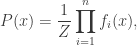
where  is a normalizing constant. If the set
  is very large, then it may be difficult to compute
  or sample from
  . To approximately sample from we can run an ergodic Markov chain with as a stationary distribution. Adding auxiliary variables is one way to create such a Markov chain. For each
  , we add a auxiliary variable
  such that
![\displaystyle{P(U \mid X) = \prod_{i=1}^n \mathrm{Unif}[0,f_i(X)]}.](https://s0.wp.com/latex.php?latex=%5Cdisplaystyle%7BP%28U+%5Cmid+X%29+%3D+%5Cprod_%7Bi%3D1%7D%5En+%5Cmathrm%7BUnif%7D%5B0%2Cf_i%28X%29%5D%7D.&bg=ffffff&fg=333333&s=0&c=20201002)
That is, conditional on  , the auxiliary variables
  are independent and
  is uniformly distributed on the interval
 ![[0,f_i(X)]](https://s0.wp.com/latex.php?latex=%5B0%2Cf_i%28X%29%5D&bg=ffffff&fg=333333&s=0&c=20201002) . If is distributed according to
. If is distributed according to  and have the above auxiliary variable distribution, then
![\displaystyle{P(X,U) =P(X)P(U\mid X)\propto \prod_{i=1}^n f_i(X) \frac{1}{f_i(X)} I[U_i \le f(X_i)] = \prod_{i=1}^n I[U_i \le f(X_i)]}.](https://s0.wp.com/latex.php?latex=%5Cdisplaystyle%7BP%28X%2CU%29+%3DP%28X%29P%28U%5Cmid+X%29%5Cpropto++%5Cprod_%7Bi%3D1%7D%5En+f_i%28X%29+%5Cfrac%7B1%7D%7Bf_i%28X%29%7D+I%5BU_i+%5Cle+f%28X_i%29%5D+%3D+%5Cprod_%7Bi%3D1%7D%5En+I%5BU_i+%5Cle+f%28X_i%29%5D%7D.&bg=ffffff&fg=333333&s=0&c=20201002)
This means that the joint distribution of  is uniform on the set

Put another way, suppose we could jointly sample from the uniform distribution on  . Then, the above calculation shows that if we discard
  and only keep , then will be sampled from our target distribution .
The auxiliary variables sampler approximately samples from the uniform distribution on is by using a Gibbs sampler. The Gibbs samplers alternates between sampling  from
from  and then sampling
  from
from  . Since the joint distribution of is uniform on , the conditional distributions
  and are also uniform. The auxiliary variables sampler thus transitions from to according to the two step process
- Independently sample uniformly from .
- Sample uniformly from the set
 .
.
Since the auxiliary variables sampler is based on a Gibbs sampler, we know that the joint distribution of will converge to the uniform distribution on . So when we discard , the distribution of will converge to the target distribution !
Auxiliary variables in practice
To perform step 2 of the auxiliary variables sampler we have to be able to sample uniformly from the sets

Depending on the nature of the set and the functions  , it might be difficult to do this. Fortunately, there are some notable examples where this step has been worked out. The very first example of auxiliary variables is the Swendsen-Wang algorithm for sampling from the Ising model [2]. In this model it is possible to sample uniformly from
  . Another setting where we can sample exactly is when is the real numbers
  and each is an increasing function of
  . This is explored in [3] where they apply auxiliary variables to sampling from Bayesian posteriors.
There is an alternative to sampling exactly from the uniform distribution on . Instead of sampling uniformly from , we can run a Markov chain from the old that has the uniform distribution as a stationary distribution. This approach leads to another special case of auxiliary variables which is called “slice sampling” [4].
References
[1] Andersen HC, Diaconis P. Hit and run as a unifying device. Journal de la societe francaise de statistique & revue de statistique appliquee. 2007;148(4):5-28. http://www.numdam.org/item/JSFS_2007__148_4_5_0/
[2] Swendsen RH, Wang JS. Nonuniversal critical dynamics in Monte Carlo simulations. Physical review letters. 1987 Jan 12;58(2):86. https://journals.aps.org/prl/abstract/10.1103/PhysRevLett.58.86
[3] Damlen P, Wakefield J, Walker S. Gibbs sampling for Bayesian non‐conjugate and hierarchical models by using auxiliary variables. Journal of the Royal Statistical Society: Series B (Statistical Methodology). 1999 Apr;61(2):331-44. https://rss.onlinelibrary.wiley.com/doi/abs/10.1111/1467-9868.00179
[4] Neal RM. Slice sampling. The annals of statistics. 2003 Jun;31(3):705-67. https://projecteuclid.org/journals/annals-of-statistics/volume-31/issue-3/Slice-sampling/10.1214/aos/1056562461.full


![M=[q_1,q_2,\ldots,q_n] \in O_n](https://s0.wp.com/latex.php?latex=M%3D%5Bq_1%2Cq_2%2C%5Cldots%2Cq_n%5D+%5Cin+O_n&bg=ffffff&fg=333333&s=0&c=20201002)


 , the top-left entry of a matrix
  . When


 Maths to Share